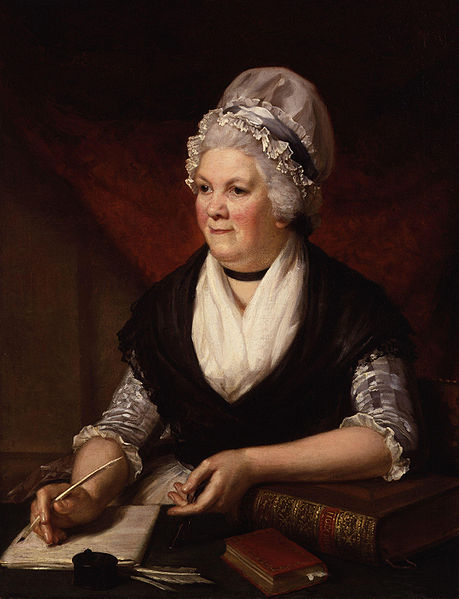
The author, Mrs. Sarah Trimmer. Image from Wikipedia.
Excerpts from 1787 version
The original 1787 version of this work included valuable references to Bernard Barton of Carlisle (1728-1773) and his horizontal flax wheel. Indeed it was diagrams and annotations from the appendix of this book that allowed Andrew Humphries et al to reconstruct the machine (see *Humphries 1984).
Extracts from the book are in the *NJB family archive on loose leaf paper:
The OECONOMY OF CHARITY; OR AN Address to Ladies concerning Sunday Schools; The Establishment of School of Industry under Female Inspection; and the distribution of voluntary benefactions. To which is added An Appendix contaning an account of the Sunday-School in Old Brentford, by Mrs. Trimmer (Sarah) London
Printed by T. Bensley; for T. Longman; G.G.J, and J. Robinson, Paternoster Row, and J. Johnson No 72 St. Paul's Churchyard
1787
Dedicated to the Queen by Sarah Trimmer, Brentford, March 10, 1787.
"After the many excellent sermons and tracts which have been published concerning Sunday Schools .... it is not my design to produce any arguments in favour of the institution in general or to attempt answering the objections which have been made against it, but merely to address to my own sex a few thoughts respecting the great advantages that would probably arise to society from their taking a more active part than it is at present usual for them to take, in the management of Sunday Schools and the personal distribution of voluntary benefactions." p1
"Wherever Sunday Schools are established, instead of seeing the streets filled on the Sabbath day with ragged children engaged at idle sports, and uttering oaths and blasphemies, we behold them assembling in schools, neat in their persons and apparel, and receiving with the greatest attention instructions suited to their capacities and conditions." p15
"....If the teachers have passed the preceding week in the laborious and fatiguing occupation of keeping schools, they stand in need of recreation and it is reasonable that the Sunday business should be made as light to them as possible; and the aid of visitors is a great encouragement to teachers and pupils." p17
"Young ladies may also, with peculiar propriety, assist in Sunday Schools; and it is particularly incumbent on them to do so, since it is for them chiefly that we are endeavouring to train up to religion and virtue servants, labourers, and merchants: the rising generation of the poor are instructed by us that our children maybe better served than their parents have been, and that when they have households of their own, "They may lie down in peace and take their rest," without the dread of being disturbed by the nightly robber; and travel the road free from the painful apprehension of being molested by the daring highwayman." p25 [She goes on to speak of the advantages of having "good principled servants"]
"Another good purpose .... is, the accustoming them to a religious observance of the Sabbath day." p30
"Perhaps it may be thought improper to take young ladies from whom genteel behaviour and elegance of expression is expected, among a set of vulgar low-bred children...." p41
"I think it is scarcely possible for any lady to go among a set of ragged children without feeling an urgent desire to clothe them better." p47
"There are in most parishes a number of women and children who would readily work, if they were put in the way of doing so; and their labour would certainly be beneficial, not only to the parish but to the nation...." [She goes on to show how they would also help themselves] "I have great reason to believe, from observation, that many men, who when they first marry, are soberly inclined, gradually become sots...." p61
"I have been informed that Houses of Industry have been established in some counties with very great success; but it is not practicable, nor indeed expedient, to collect all the poor of a parish into these seminaries: they are proper receptacles for vagabonds who must be compelled to work, but will not answer for whole families; they are at first very expensive to erect, and in this land of liberty lay too great a restraint, in many instances, on the freedom of the poor; numbers of them would work with greater alacrity if delivered from the idea of restraint and under no compulsion but what arises from pecuniary wants. I could therefore wish to see established in every parish, Schools of Industry for poor girls.
If, for instance, there was a school for spinning flax, girls of five years of age might be employed at it and the yarn might easily be manufactured into white or striped linen and checks; and by the time each little spinstress had worn out the clothes with which the parish or private benefactors should at first furnish her, she might earn sufficient to entitle her to linen and other necessaries." p69
[Another school for carding and spinning wool, a third for needlework, at a fourth "they might learn to spin stockings"]
"Young ladies might assist in this office (visiting these schools) with the greatest propriety; by which means they would obtain an early insight into domestic oeconomy, and acquire a habit of calculating expenses; a strong impression would be made on their minds in favour of industry, they would be ashamed to be idle, and would consider it as a duty to reward diligence in others.
I am happy in being able to inform my readers of a little manufactory which has benefited a neighbourhood for upwards of fourteen years, that exactly agrees with my idea of Schools of Industry, excepting in the circumstance of having but one patroness, who I hope will pardon me the liberty of using her name, as it is on so important an occasion.
About twenty years ago, the late Mr. Bernard Barton of Carlisle, a very ingenious linen manufacturer of that city, invented a kind of horizontal spinning wheel, at which twelve little girls can spin at once.
This machine is so easily managed that the least child can, with the smallest touch, disengage, or set a going, any one of its wheels without in any way interfering with another. The contrivance is so simple and ingenious that little art is required to keep it in order, provided it be properly understood at first.
Considerably less strength is required at this machine, than at the common spinning wheel; the original expense of it is about five pounds, and it seldom wants repair.
One of these wheels has been employed at Sandoe, near Hexham, in Northumberland, through the benevolence of Lady Broughton, for upwards of fourteen years, much to her own honour, and the benefit of the poor in the neighbourhood. This machine is at present under the direction of Mr. Donkin of Sandoe, Lady Broughton's steward, to whom I was most obligingly referred by her ladyship. And I hope in a very short time, through the kind communications of Mr. Donkin, and the assistance of Mr. Barton, son of the inventor, to see some of the poor children in this neighbourhood [i.e. Mrs. Trimmer's own neighbourhood, Brentford] employed at a similar one, to be purchased, and at first conducted, at the sole expense of a benevolent lady, who not only attends to the want of her poor neighbor's, but extends her charity to distant countries.
Footnote - it may not be improper to add here that the late Duchess of Northumberland, Lady Darlington, and the Earl of Surrey (now Duke of Norfolk) had each of them one of these spinning wheels, for the benefit of the poor in their respective neighbourhoods." p71
"Were such schools established, I am persuaded we should, in a very short time, see poor people in general decently clothed: many women, who have sat by their spinning wheels as useless lumber, would bring them to light again; others would be induced to learn to spin, and families would not suffer such distresses as they frequently do for want of linen, for women and girls would be ambitious of having plenty; and the latter might, as in former days, provide a stock to save as a little marriage
portion: neither should we see the men and boys, as they often are, without stockings: clothes and linen would not go to destruction as is now the case, through the incapacity of mothers and daughters to mend them." p74
"I am assured that the wheel before mentioned has been attended with every desirable degree of success; and I should hope would answer in any place which has a communication with a firm that furnishes a loom. It is further intended to encourage women to spin for their families, by paying them for their work or giving them an equivalent, for the price of their labour, in linen." p75
APPENDICES
Description of the Plates
Plate 1st
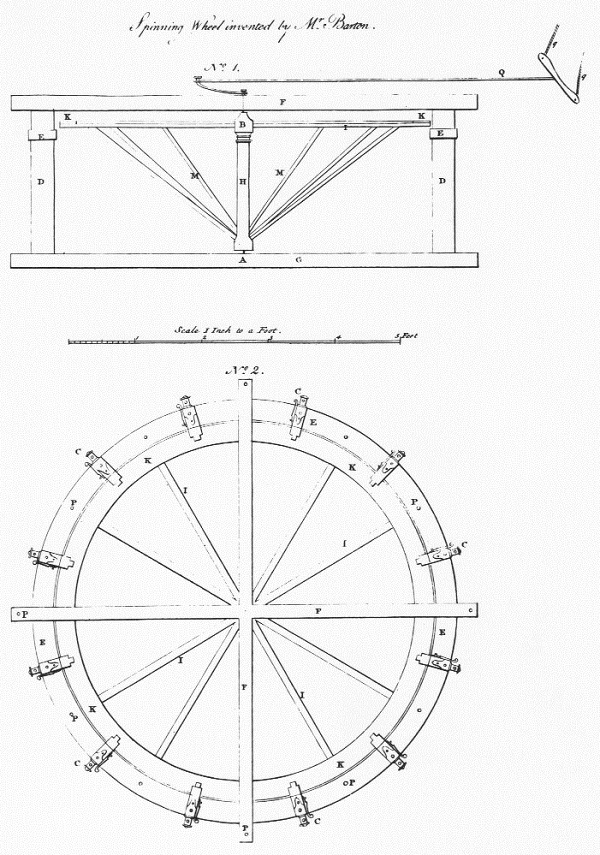
[What follows is set in columns headed "Scantling" with column headers "Inches" and "Inches", however for clarity I have here inserted "inches" and "by" in between the numbers given.]
ADEFG The frame, which has
D four legs - - 4½ inches by ½ inches
E a circular rail framed into the legs near the top, on which are placed the bobbins C - - 5 inches by 1 inch
F Two cross rails framed on the heads of the legs - - 2½ inches by 2½ inches
G Two rails framed into the lower part of the legs, and which are fixed to the floor to steady the machine - - 2½ inches by 2½ inches
BHIKM The wheel, (which is 5 feet 7 inches diameter) has a
H column, or axis, into which are framed
I Twelve spokes - - 1 3/8 inches by 7/8 inches
M Twelve braces framed from the bottom of the column into the spokes - - 6/8 inches by 5/8 inches
C The bobbins, more particularly described in plate 2d.
P holes in the circular rail, etc, to receive the distafts.
Q The handle by which the wheel is turned, and which is suspended from the celling, or upper part of the room, by the cords q q
NB The corresponding parts of the machine in No 1 and No 2 plate 1st are marked with the same letters.
Plate 2d.
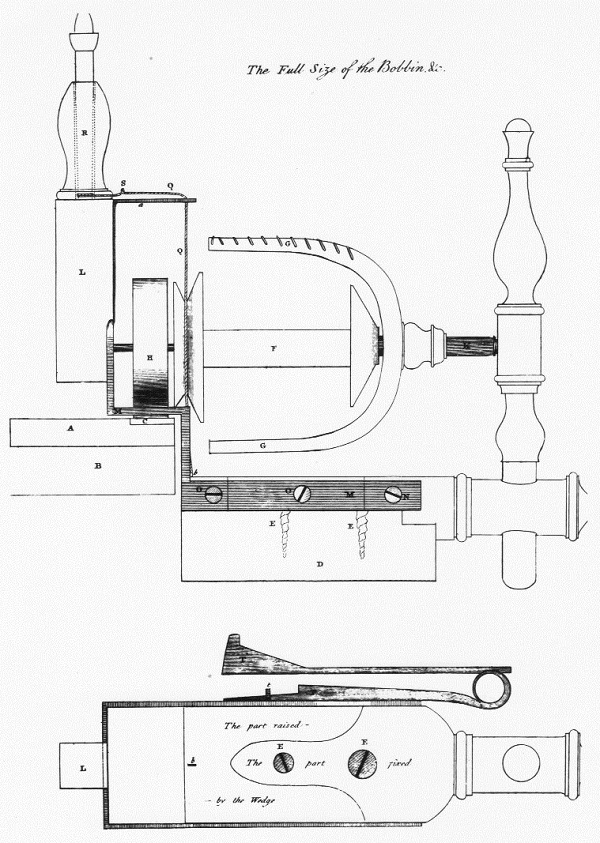
Represents the full size of the bobbin, which is almost exactly the same as that used in the common spinning-wheel; the principal difference consisting in this, that as the bobbin of the common spinning wheel is carried round by a band, the bobbins of this machine are carried round by pressing on the upper surface of the rim, or pulley, of the large wheel described in plate 1st.
A The rim, or pulley, of the large wheel
B The extreme end of one of the spokes on which the rim rests
C A piece of leather let into that part of the rim on which the whirlers H of the bobbins press, and which is intended to increase their friction.
D The circular rail which is framed into the legs; and upon which are fixed the bobbins by means of the screws EE
F The quill which turns round on the spindle IK.
G The carriers, which are fixed to the spindle.
H The whirler, also fixed to the spindle, and which presses on the leather C
IK The spindle, which is supported at the end K as in the common spinning wheel, and at the other end runs in a hole or socket in the lower part of the pillar L, which is supported by the iron plate MM
MM An iron plate which moves on the screws N as a centre, and which is made fast to that part raised by the wedge, by the screws OO, so that, when the wedge, P is drawn out, the whirler H is raised above the rim of the wheel, and thereby stopped, notwithstanding the wheel is still kept turning.
Q The band, which, by being made tighter or slacker, causes the quill F to take up the thread faster or slower, at the pleasure of the spinstress. This band is fastened at one end to the pin R, round which it turns, and is there single. From S it is double, and passes through a small hole near one end of the iron plate a. From thence it passes on each side of the quill F, in a groove made for its reception, and is kept fast at bottom by a small wire staple b.
T Represents the flat side of the wedge P, which, when pulled out, acting upon the pin T, raises the whirler off the wheel as before described. When the wedge is thrust in again, the whirler falls upon the wheel by its own weight, and is again carried round. Hence, by this simple contrivance; any one of the bobbins may be stopped or set a going, at the pleasure of each spinstress, without at all interfering with any of the others.
Revised 1801 Version
Mrs Trimmer published a revised version with the same name, in two volumes, in 1801, with substantially different contents, as she herself noted in the 'Advertisement' at the beginning of volume 1:
"As the following Work, though formed upon the same Principle, differs greatly in its Contents from that which, I published in the year 1787 under the same title, it is necessary for me to account for the alterations I have made."
There is no sign in this version of any mention of Bernard Barton or his spinning wheel, much less of the invaluable appendix information which allowed the wheel to be reconstructed (see *Humphries 1984).
Volume 1 of this 1801 version is online here and volume 2 is online here.